
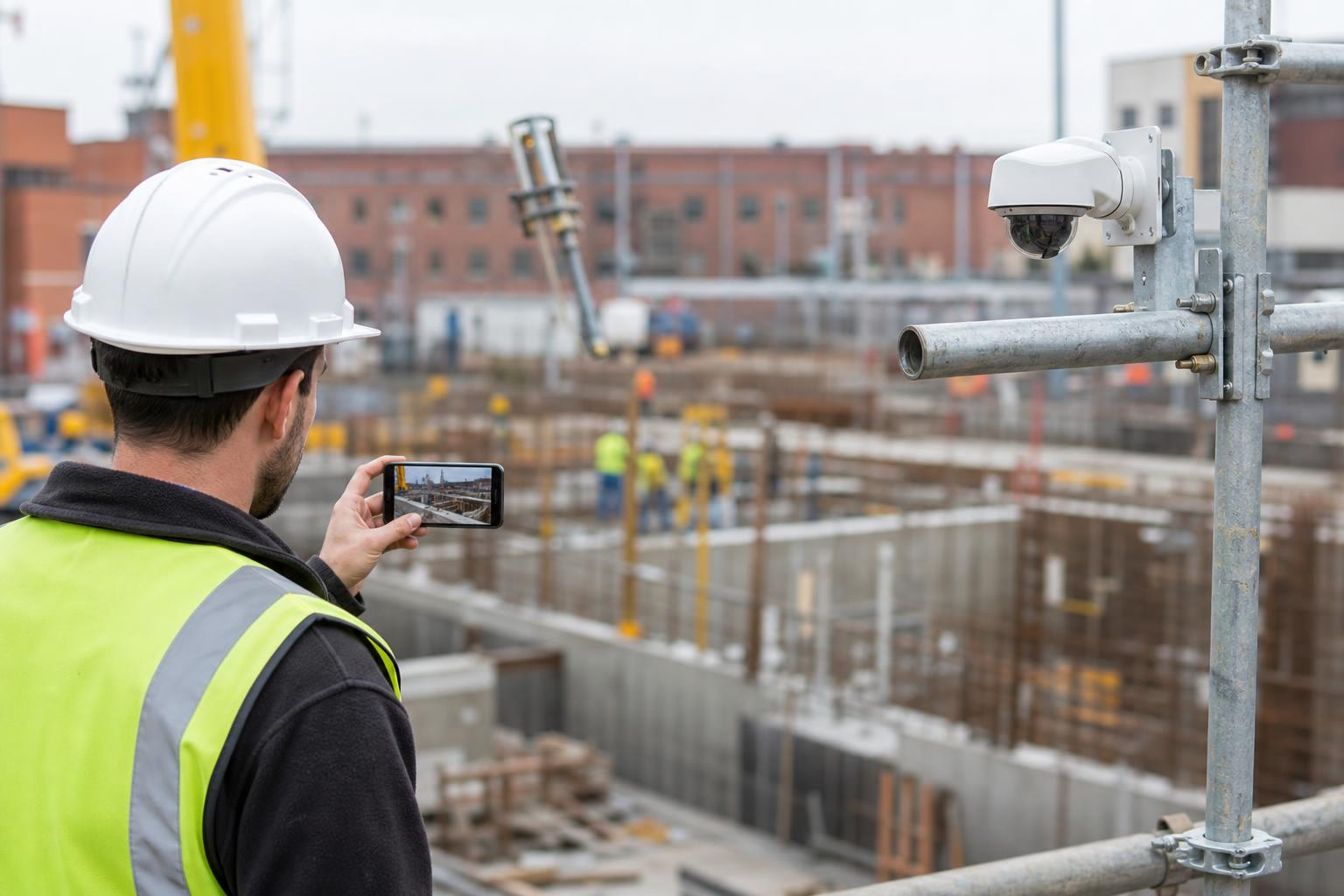
Jobsite surveillance delivers far more than theft prevention. Modern camera systems reduce security costs by up to 70%, cut theft incidents by half, and provide daily operational visibility that eliminates unnecessary site visits. The biggest gains often come from progress documentation, weather delay proof, dispute resolution, and stakeholder collaboration, not just catching criminals. This guide breaks down every benefit category with real statistics and practical context.
Construction teams that install cameras quickly discover something surprising: security is just the starting point. The full range of jobsite surveillance benefits spans theft deterrence, cost savings, remote project management, legal protection, and even marketing. Yet most online resources treat surveillance as a single-purpose tool, listing a few advantages without the data or nuance that decision-makers need.
This guide takes a different approach. It defines jobsite surveillance in clear terms, walks through each benefit category with sourced statistics, and covers the overlooked advantages that competing resources miss entirely.
Explore live demo cameras to see how modern construction surveillance works in practice.
Jobsite surveillance is the use of camera systems to monitor construction sites for security, safety, documentation, and project management purposes. Modern systems are wireless, weatherproof, and cellular-connected, operating on LTE or 5G networks without requiring site internet or hardwired infrastructure.
A few key terms matter for understanding the technology:
PTZ (Pan-Tilt-Zoom) cameras rotate horizontally and vertically while zooming optically into distant areas. A single 4K PTZ camera can cover multiple vantage points using saved presets, each generating its own time-lapse sequence.
Static cameras provide a fixed, wide-angle view. They’re simpler but effective for consistent documentation from one angle.
Monitored vs. unmonitored surveillance is a critical distinction. Unmonitored systems record footage for later review. Monitored surveillance adds human-reviewed alerts, two-way audio for talk-down deterrence, and escalation to police or site contacts within seconds.
Cloud storage means images and video are retained on secure servers, not on local hard drives vulnerable to theft or damage. Most systems archive images indefinitely while keeping full DVR video available for 10 to 21 days depending on the camera model.
Time-lapse documentation automatically stitches captured images into video sequences showing construction progress over days, weeks, or months.
These systems run on cellular networks (primarily Verizon LTE/5G in the U.S.) and can be powered by solar kits, making them functional on Day 1 of a project before utilities are connected.
This is the benefit everyone searches for first, and the numbers justify the concern.
Construction equipment theft costs the U.S. industry an estimated $300 million to $1 billion annually, according to data from the National Equipment Register (NER) and the National Insurance Crime Bureau (NICB). More than 11,000 incidents are reported each year, roughly 1,000 per month. Only about 21% of stolen equipment is ever recovered.
The scale of the problem is staggering. The BauWatch 2024 Construction Crime Index found that 70% of construction workers report witnessing theft on job sites annually. Theft adds an estimated 1 to 5% to overall project costs, impacting budgets, timelines, and insurance premiums.
Surveillance works against this. Construction sites with visible warning signs about cameras are 42% less likely to experience theft. Camera systems can reduce theft incidents by up to 50%.
The mechanism is layered. Visible cameras deter casual opportunists. Motion detection alerts catch after-hours intrusions in real time. Monitored systems with talk-down speakers allow a remote operator to address trespassers directly, often ending the incident before anything is taken. And when theft does occur, recorded footage provides evidence for police reports and insurance claims.
Practitioners on Reddit confirm this math works in practice. Multiple users in construction management forums report that cameras pay for themselves after a single prevented theft or won dispute, making the ROI calculation straightforward for even skeptical project managers.
The economics of surveillance versus security guards are lopsided.
An unarmed security guard typically costs $15 to $30 per hour depending on the state. An armed guard runs $45 to $60 per hour. For after-hours coverage alone (roughly 14 hours on weekdays plus full weekends), a single unarmed guard costs $2,600 to $5,200 per month.
Camera surveillance costs a fraction of that while providing 24/7 coverage with recorded evidence. Construction businesses report reductions of up to 70% in security staff operating costs after switching to monitored camera systems, with response times under 30 seconds for detected suspicious activity.
Here’s a practical comparison:
Factor | Security Guard | Camera Surveillance |
|---|---|---|
Monthly cost | $2,600 - $10,400+ | $260 - $425 (service) |
Coverage hours | Shift-limited | 24/7/365 |
Evidence capture | Eyewitness only | HD video + images |
Scalability | Linear cost increase | Minimal marginal cost |
Multi-site visibility | Separate guard per site | Single portal, all sites |
Response capability | On-site but one person | Remote alert + escalation |
Guards still make sense for certain high-risk scenarios. But for most construction sites, cameras deliver broader coverage at a fraction of the cost.
View current camera pricing to compare costs for your project.
Ask construction managers what they value most about jobsite cameras, and the answer often isn’t security. It’s the ability to check on a project without driving to the site.
A thread in r/ConstructionManagers on Reddit reveals what real users care about: “getting a high-level view of progress, checking weather impacts, or seeing whether crews and deliveries showed up.” These are daily operational questions, not security concerns, and cameras answer them in seconds from a phone or laptop.
For project managers overseeing multiple jobs, a single web portal showing every site eliminates hours of windshield time each week. The practical value is enormous:
Verify that concrete trucks arrived on schedule
Confirm crew sizes and subcontractor presence
Check equipment positioning before calling a crane operator
Review site conditions after a storm without a two-hour drive
Share a live view with an owner who calls with questions
Community discussions consistently highlight that the biggest practical value is often not security but remote check-ins that eliminate unnecessary site visits. Multi-project managers especially value seeing all their sites from one dashboard.
Systems that support 50 or more simultaneous users and unlimited account creation solve another real problem: credential sharing. On a typical commercial project, owners, general contractors, subcontractors, architects, lenders, and municipal inspectors may all need access. Unlimited accounts mean each stakeholder logs in with their own credentials, sees what they’re authorized to see, and doesn’t bottleneck anyone else.
Beyond security and remote access, jobsite surveillance benefits extend into project documentation, an area where cameras quietly deliver outsized value.
Cloud-based storage enables project managers to review incidents, document progress, and generate time-lapse video recaps for stakeholder updates. PTZ cameras with multiple presets can capture several angles from one unit, each preset producing its own time-lapse sequence. A single camera covering four presets generates four distinct progress timelines automatically.
This documentation serves multiple purposes:
Pay application support. Timestamped images verify what work was completed during a billing period, reducing disputes between GCs and owners over percent-complete calculations.
Schedule verification. When a subcontractor claims they were on site for five days and you only see three in the footage, the conversation changes quickly.
Milestone tracking. Foundation pours, steel erection, topping out, enclosure completion. Each milestone is captured automatically without anyone remembering to take photos.
Marketing and business development. Time-lapse footage of a completed project is a powerful marketing asset. It works for investor presentations, portfolio building, social media content, and client proposals. A 60-second video showing a building rise from dirt to occupancy tells a story that static photos never can.
For a 4K static camera mounted in a fixed position, the documentation value is consistent and hands-free. The camera captures the same frame every interval, building a visual record that requires zero effort from the project team.
Construction is a litigious industry. Jobsite surveillance benefits include creating an objective, timestamped record that protects everyone involved.
Video footage verifies or disproves worker’s compensation claims. In 2023, falls, slips, and trips alone accounted for 421 fatalities in construction, most commonly falls to a lower level. When an injury claim is filed, security footage can clarify circumstances and protect companies against unfounded allegations.
But liability protection extends well beyond injury claims:
Subcontractor disputes. Did the electrician finish their rough-in before the drywall crew showed up? Footage settles the question.
Material delivery verification. When a supplier claims they delivered 40 pallets and only 32 appear on camera, you have leverage.
Schedule disputes. If a subcontractor claims they couldn’t access the site, but footage shows the gate was open and no crews arrived, the argument evaporates.
OSHA investigations. When an inspector asks what happened, timestamped video is more reliable than anyone’s memory.
This documentation creates an objective record for arbitration and litigation. In an industry where disputes over schedule, scope, and responsibility are constant, visual evidence eliminates the “he said, she said” dynamic that makes resolution so expensive.
This is one of the most underappreciated jobsite surveillance benefits, and almost no one talks about it.
Schedule disputes over weather delays are a constant pain point for general contractors managing pay applications and extension-of-time requests. When a contractor claims five rain days in a month and the owner only acknowledges two, the argument often comes down to conflicting weather reports from stations miles from the actual site.
Camera systems with weather overlays solve this problem directly. Date-stamped images captured at the jobsite, paired with on-site weather data, create hard evidence of actual conditions. This matters for:
Rain delay claims in scheduling disputes
Force majeure documentation for contract modifications
Extension-of-time requests submitted to owners
Liquidated damages defense when project completion dates slip
The difference between a weather station 10 miles away saying “0.2 inches of rain” and a jobsite photo showing standing water on the excavation pad is the difference between a denied claim and an approved one.
This is a feature worth investigating when evaluating cameras. Systems that combine timestamped imagery with local weather data give contractors a documentation tool that goes far beyond what traditional weather services provide. You can explore these camera features in more detail.
Construction remains one of the most dangerous industries in the United States. OSHA’s “Fatal Four” hazards (falls, struck-by, electrocution, caught-in/between) account for the majority of worker deaths, and the 2023 data showing 404 fatal falls to a lower level underscores the ongoing risk.
Live camera feeds allow safety managers and supervisors to spot violations without being physically present:
Workers without harnesses near leading edges
Missing guardrails or hole covers
Blocked emergency access routes
Improper crane rigging visible from the camera angle
PPE violations (hard hats, high-visibility vests)
This isn’t about catching people doing wrong. It’s about intervening before someone gets hurt. A safety manager watching a live feed who spots a worker near an unprotected edge can call the site super immediately, potentially preventing a fatality.
Recorded footage also supports safety training programs. Real incidents (or near-misses) captured on camera are more effective training materials than generic stock footage. When workers see their own jobsite on screen, the lesson hits differently.
Surveillance can reduce insurance costs, but the picture is more nuanced than many vendors suggest.
AI-monitored camera systems can cut commercial insurance premiums by 5 to 20%. Given that insurance premiums typically represent 1 to 4% of a total project’s cost, the savings on a multi-million dollar build can be significant.
However, honesty matters here: while security cameras can have a positive impact on your insurance situation, their presence doesn’t guarantee a lower premium. The factors that insurers actually reward include:
Professional monitoring with real-time alerts and human review
Documented response protocols showing how alerts are handled
Evidence of reduced claims history over time
Integration with alarm and access control systems
An unmonitored camera recording to a local DVR probably won’t move the needle with most carriers. A professionally monitored system with talk-down capability, police escalation, and cloud-stored evidence is a different conversation entirely.
The claims protection value, avoiding a single large theft or winning a disputed liability claim, often exceeds any premium discount over the lifetime of a project. Think of insurance savings as a bonus, not the primary financial justification.
Large construction projects involve dozens of stakeholders who need visual information but don’t need (or want) to visit the site. Jobsite surveillance benefits this communication layer in ways that email updates and phone calls simply can’t match.
Embeddable live feeds let owners place a camera view on their website for public viewing, investor portals, or community updates. This is especially valuable for civic projects, hospitals, and university builds where public interest is high.
Scheduled email updates deliver images at set intervals (daily, weekly) to specific recipients. A lender might receive a Monday morning photo showing progress since their last draw inspection. An architect might get a daily image confirming their design is being built correctly.
Image tagging and comparison tools allow users to pull up two photos from different dates side by side, making before-and-after comparisons simple for reporting. These features turn raw camera output into structured project communication.
When a system supports unlimited user accounts and 50+ simultaneous viewers, everyone from the owner’s representative to the structural engineer to the city inspector can log in independently. No shared passwords, no access bottlenecks, no IT headaches.
The most vulnerable period for a construction site is often the earliest one, when fencing is minimal, equipment gets staged, and there’s no power or internet. This is precisely when surveillance is hardest to deploy with traditional systems.
Modern jobsite cameras solve this with two technologies: cellular connectivity and solar power.
LTE and 5G modems built into the camera connect directly to cellular networks, eliminating any need for site internet. A solar power kit with panels, batteries, and a charge controller provides 24/7 operation without grid power. The camera goes live on the pole the same day it arrives.
This matters operationally because:
Early-phase sites have the least physical security (no permanent fencing, no lighting, no occupied structures)
Staged equipment and materials are sitting in the open
The site super can install the camera themselves without waiting for an electrician or IT vendor
Quick shipping (typically 1 to 3 business days for nationwide deployment) aligns with mobilization timelines
Plug-and-play installation is not a marketing phrase here. It’s a practical requirement. Community discussions on Reddit and construction forums consistently note that complex camera installations get deprioritized or abandoned entirely. If a site super can’t mount it and turn it on in under an hour, it won’t happen during the chaos of mobilization.
Benefit Category | Key Takeaway |
|---|---|
Theft deterrence | Cuts theft incidents by up to 50%; visible cameras reduce likelihood by 42% |
Cost savings | Up to 70% reduction versus security guard costs |
Remote visibility | Eliminate unnecessary site visits; manage all projects from one portal |
Progress documentation | Automated time-lapse, pay app support, milestone tracking |
Liability protection | Timestamped video resolves disputes over injuries, schedule, and scope |
Weather documentation | On-site imagery with weather data proves delay claims |
Safety compliance | Real-time monitoring catches PPE violations and hazards before injuries occur |
Insurance savings | 5 to 20% premium reduction possible with monitored systems |
Stakeholder communication | Embeddable feeds, scheduled updates, unlimited user access |
Off-grid deployment | Solar + LTE means Day 1 surveillance before utilities exist |
The range of jobsite surveillance benefits has expanded well beyond catching thieves. The construction teams getting the most value from their cameras are using them for daily operations, client communication, legal protection, and marketing, treating security as one benefit among many.
Request a free camera quote to see what coverage looks like for your project.
Remote visibility. The ability to check site conditions, verify deliveries, confirm crew attendance, and review progress without driving to the jobsite saves project managers hours every week. For multi-site managers, this alone justifies the investment.
The NER and NICB estimate annual losses between $300 million and $1 billion in the United States. Individual incidents average $1,000 to $3,000 in losses, but major equipment thefts can easily reach six figures. Only about 21% of stolen equipment is ever recovered.
Possibly. Professionally monitored systems with real-time alerts can reduce commercial insurance premiums by 5 to 20%, but this depends on your carrier and the specifics of your system. Unmonitored cameras are less likely to qualify for discounts. Always confirm with your insurer before assuming savings.
Camera systems that capture timestamped images with weather data overlays create site-specific evidence of actual conditions. This is far more convincing in a scheduling dispute than referencing a weather station miles away. The imagery supports rain delay claims, extension-of-time requests, and force majeure documentation.
No. Modern jobsite cameras use built-in LTE or 5G cellular modems and connect directly to carrier networks. Combined with a solar power kit, cameras can operate completely off-grid from Day 1 of a project, before any utilities are connected.
Unmonitored systems record footage that you review later. Monitored systems add a human layer: trained operators review motion alerts in real time, use two-way speakers for talk-down deterrence, and can escalate to site contacts or police within seconds. Insurers and law enforcement strongly favor monitored systems.
This varies by provider. Some systems support 50 or more simultaneous viewers with unlimited user accounts, which matters on large projects where owners, general contractors, subcontractors, architects, lenders, and inspectors all need independent access.
Absolutely. Time-lapse videos showing a project from groundbreaking to completion are among the most effective marketing assets in construction. They work for investor presentations, social media content, client proposals, and portfolio building. Many teams consider the time-lapse deliverable one of the highest-value outputs of their camera investment.